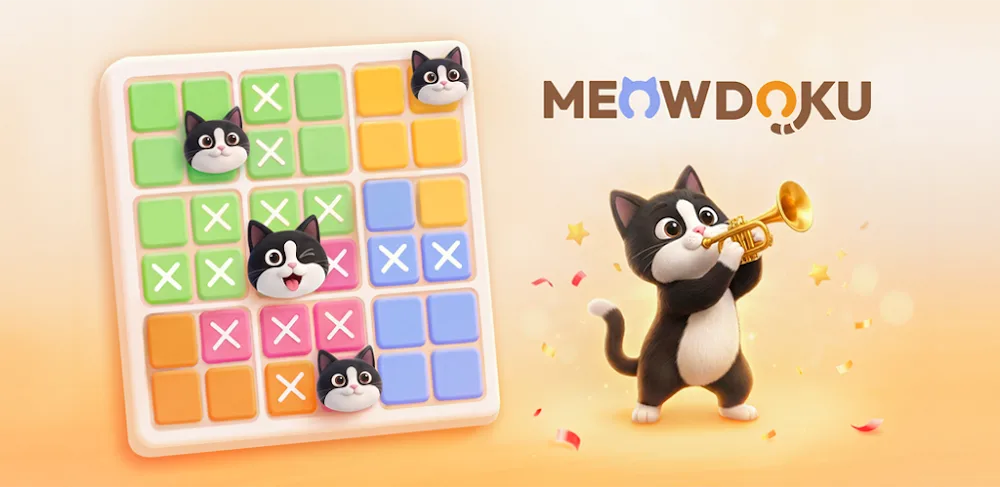

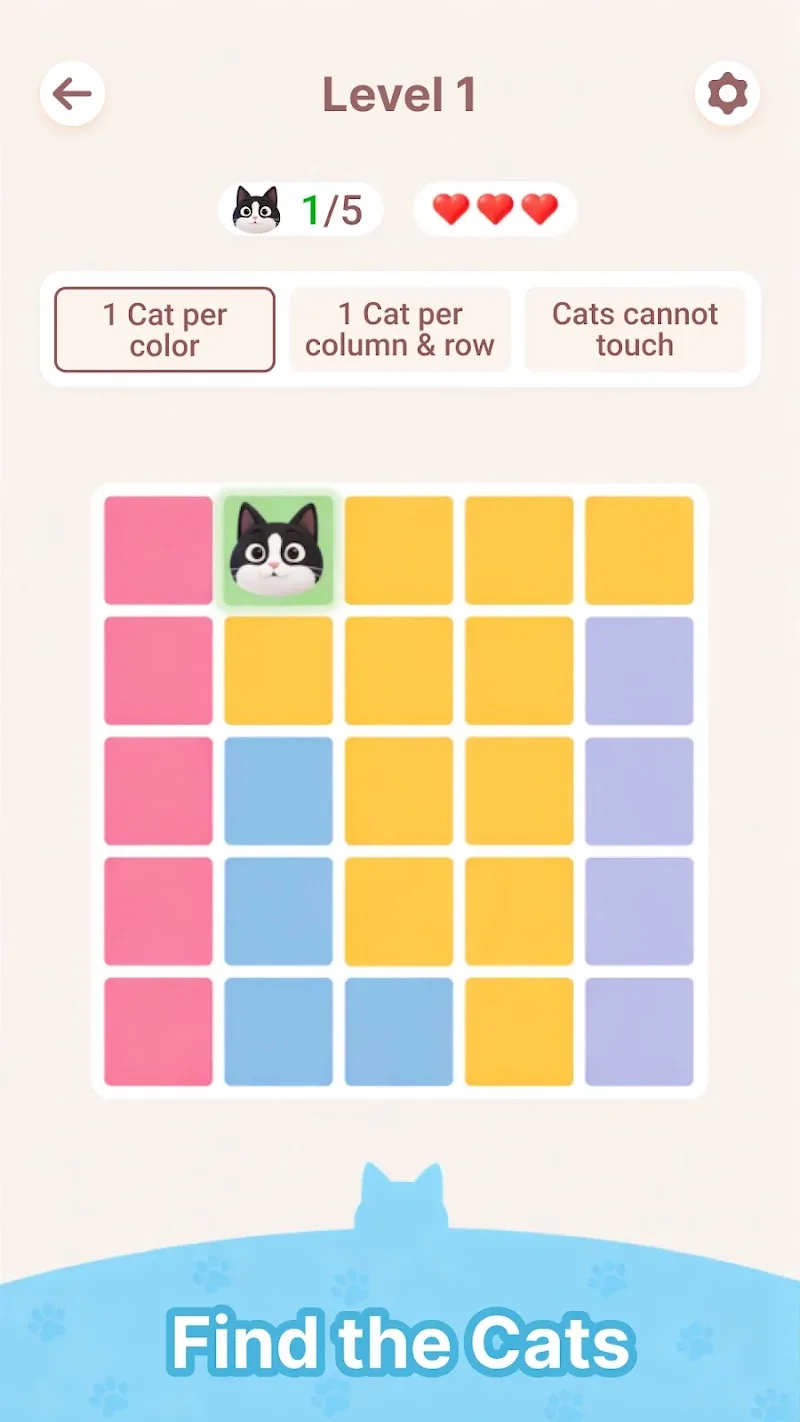
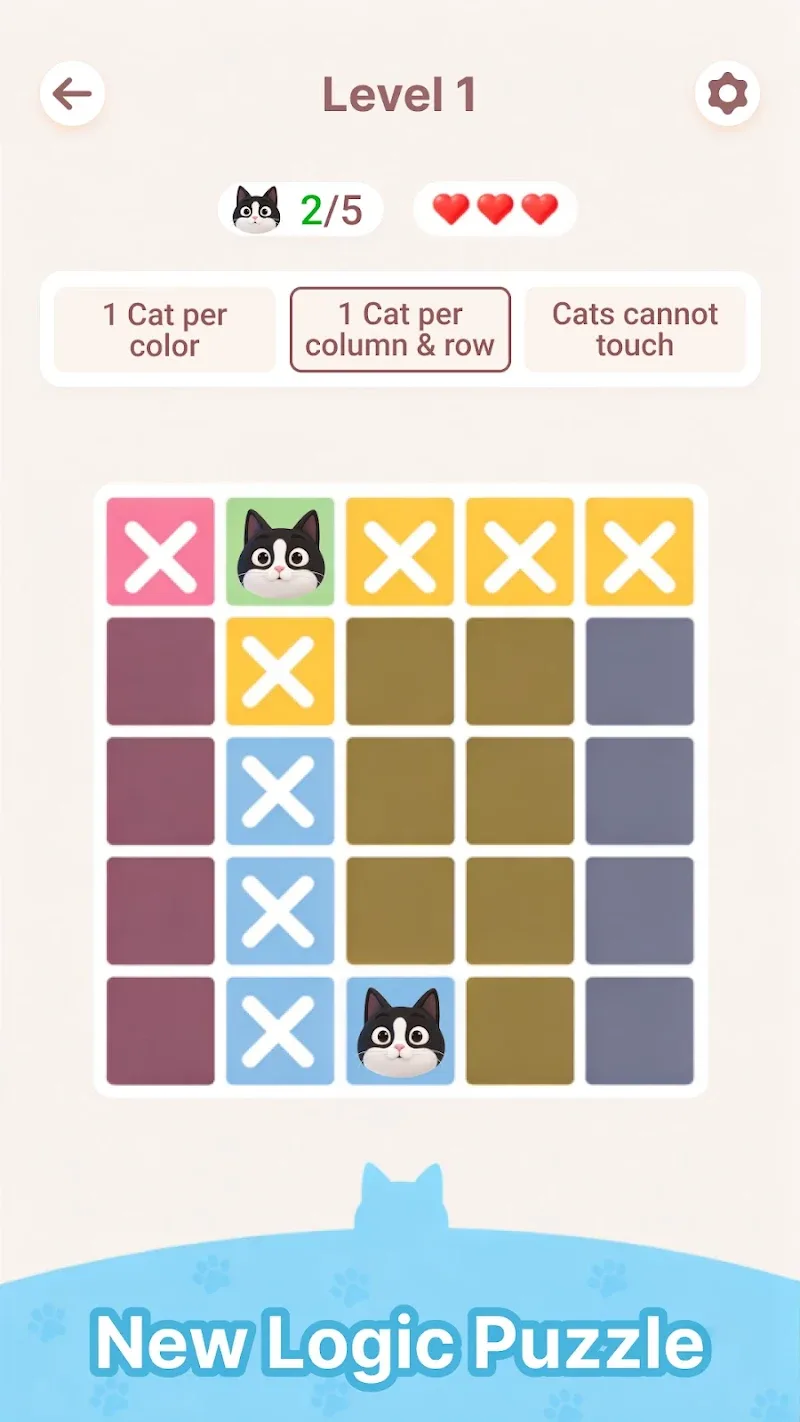
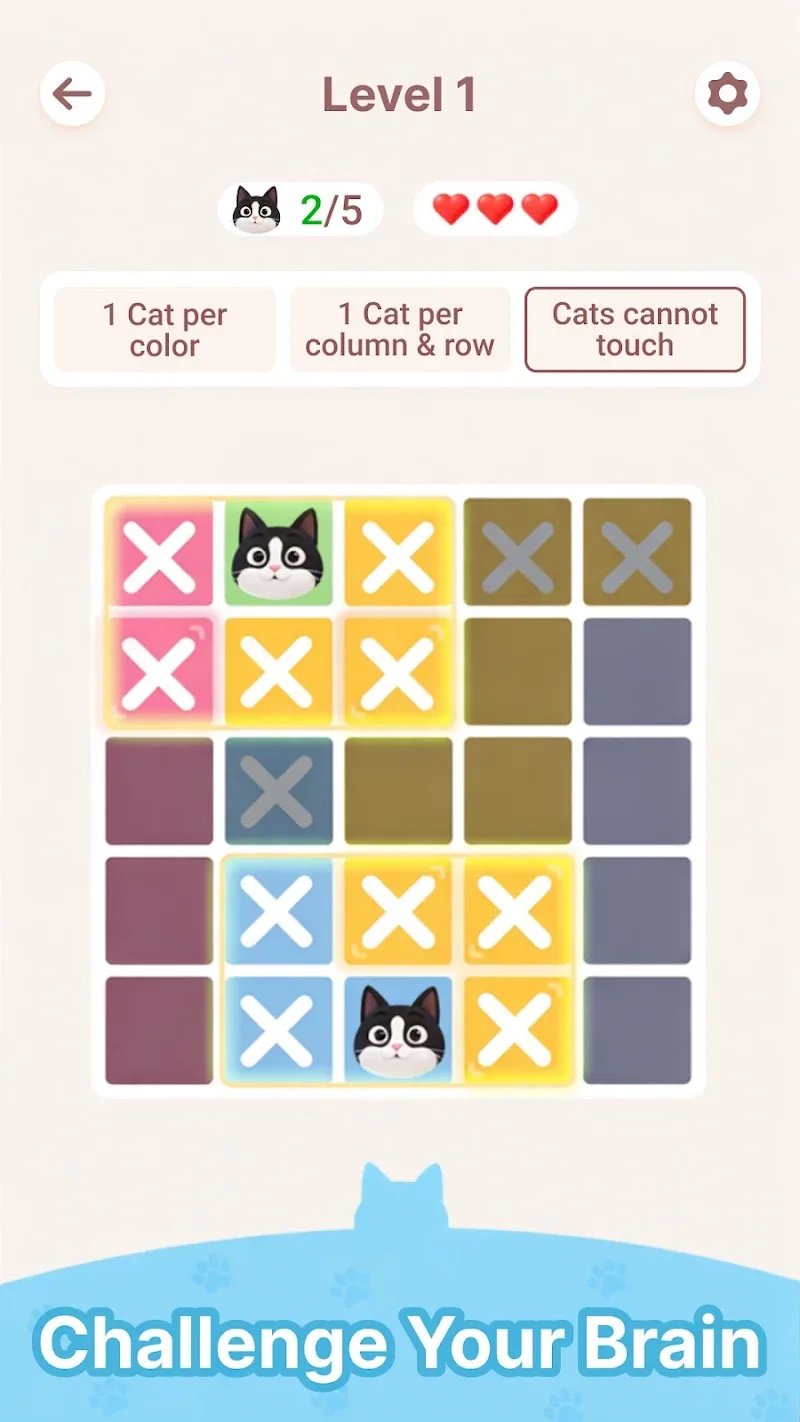
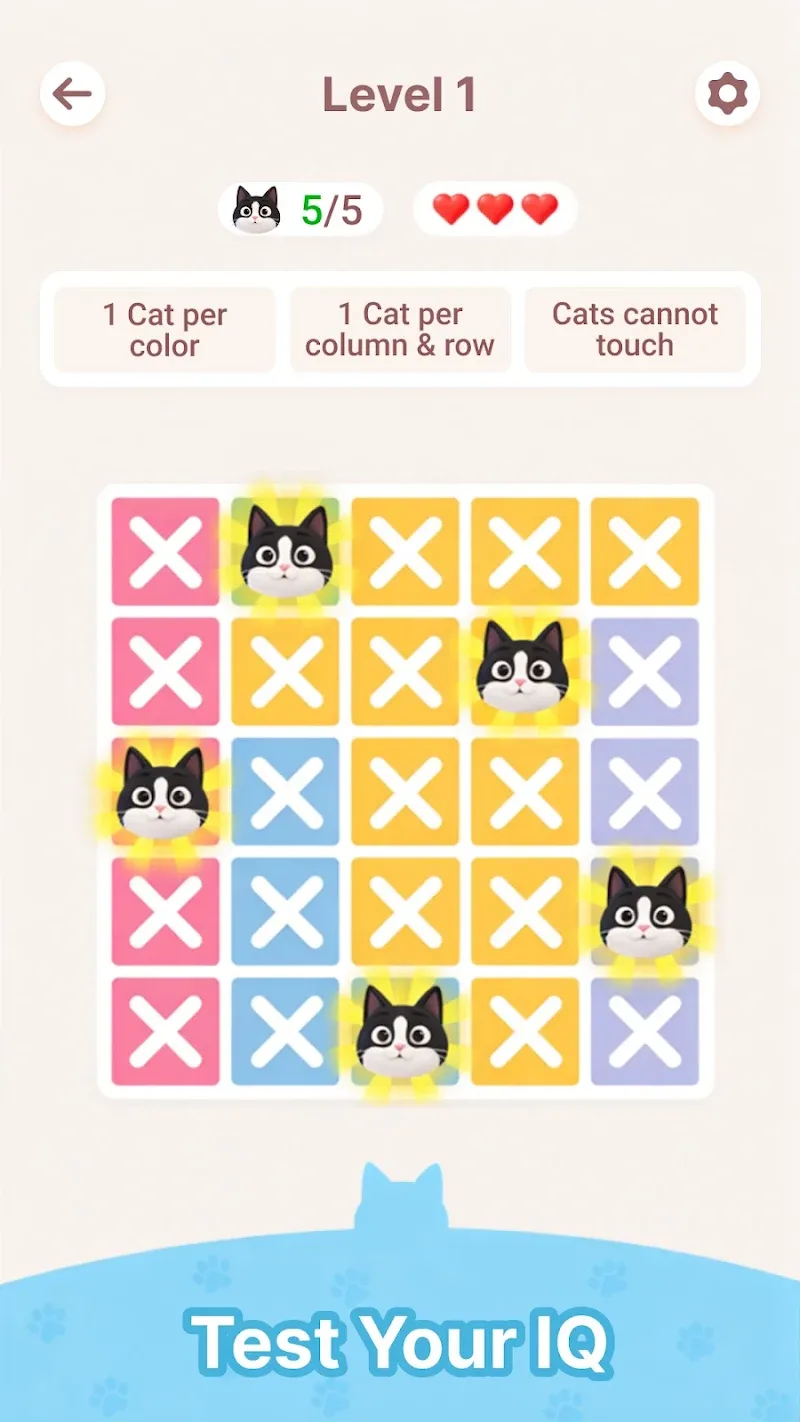
Meowdoku is a cat-themed logic puzzle game about finding one spot for each cat on a colored grid. It borrows the discipline of Sudoku without asking you to fill in numbers: every colored region needs exactly one cat, and no two cats can share a row or column. They can’t touch diagonally, either. One placement can rule out several others at once.
Give Every Cat Its Own Space
The colored regions aren’t just decoration. Each one needs a cat, so a promising square must satisfy the region rule and the row-and-column rules at the same time. A square that looks open may still be wrong because another cat would sit too close diagonally. That extra restriction is where a simple-looking board starts to demand careful attention.
A useful way to read the puzzle is to work backward from what can’t fit. Once you place a cat, no other square in its row, column, or colored region can hold one. If a region has only one viable square left, that decision can narrow the choices elsewhere. You don’t need to race through the grid; the interesting part is watching a chain of exclusions turn uncertainty into a placement you can justify.
Despite the name, this isn’t conventional Sudoku with cats substituted for digits. The comparison describes the one-per-area logic, while the colored shapes and no-touch rule give you different clues to follow. It’s a better fit if you enjoy eliminating possibilities than if you’re looking for a standard number grid.
Think Before You Double-Tap
You place a cat by double-tapping a tile. That action matters because the game gives you three mistakes, represented by hearts; a wrong placement costs one. The hearts add some weight to a choice that might otherwise be a harmless guess. If two squares both seem plausible, it’s worth checking their rows, columns, regions, and diagonal neighbors again before committing.
The objective isn’t to cover the board quickly but to find a consistent position for every cat. A nearly finished puzzle can still hinge on one overlooked diagonal conflict. The rules are brief, but a stubborn region may require several rounds of elimination before its cat has a definite home.
A Daily Puzzle, With Room to Play Offline
Beyond individual boards, the game offers daily puzzles and a leaderboard built around completion times. The daily challenge gives you a specific board to return to, while the timing element offers a separate goal once you’ve learned to solve accurately. It doesn’t change the placement rules: faster still has to mean correct.
Offline play is available, which makes the core puzzle suitable for a commute or a quiet break without a connection. If you prefer to take your time, the colored grid gives you plenty to consider before the next double-tap.










Comments (0)
No comments yet. Be the first!